














The future of dental care: AI, 3D printing, digital prevention – what is technology changing?
AI, 3D printing, prevention: what it means for you.
Dentistry is changing rapidly thanks to technological advances. What seemed like science fiction just a few years ago is now part of (or will soon be part of) everyday life in dental clinics. Artificial intelligence, 3D printing, digital prevention tools : these innovations are revolutionizing the way dental care is planned and delivered. But in practical terms, what do they change for you, the patient? Better diagnoses, faster treatments, less stressful experiences… In this article, we explore the future of high-tech dental care, which is already underway, and how technology is improving the precision, speed, and comfort of treatments. Fasten your seatbelts: we’re heading into the dental clinic of the future!
Artificial Intelligence for more accurate diagnoses
Today,AI is increasingly making its way into medicine, and dentistry is no exception. Artificial intelligence software now analyzes dental X-rays and 3D scans to assist the dentist with diagnosis. For example:
- Automated detection of cavities and lesions : AI can scan a panoramic X-ray and highlight suspicious areas (early cavities, granulomas at the root tips, bone loss around the teeth). It acts as a “second pair of eyes” for the practitioner, reducing the risk of a small lesion going unnoticed.
- Assisted implantology : Dental implant placement relies on 3D scans. In just a few clicks, AI can suggest the optimal size and position of the implants to the surgeon based on the patient’s anatomy. The dentist of course reviews and adjusts, but it saves time and adds safety.
- Help diagnosing gum disease : By comparing measurements and images across several visits, AI software can objectively flag the progression of periodontitis or, conversely, an improvement.
The benefit for you, as a patient, is an earlier and more reliable diagnosis. AI doesn’t replace the dentist (it lacks the overall clinical context), but it helps make sure nothing is missed. That means treating problems at an early stage, with gentler and less expensive methods. And seeing AI highlight a cavity on the screen can help convince you that treatment is needed: it’s visual and educational.
3D printing: prostheses in record time
Today,3D printing has taken over dental laboratories, and even some clinics. It’s now possible to “print” a temporary dental crown, an aligner, or even a complete denture in just a few dozen minutes. What difference does that make?
- Faster restorations : Imagine you break a tooth. Instead of waiting a week with a temporary tooth while a crown is made at the lab, the dentist could design it digitally and print it in ceramic resin on-site in an hour. You’d leave almost immediately with your permanent crown. Some clinics equipped with CAD/CAM systems (computer-aided design and manufacturing) already do this with milling technology (CEREC). 3D printing is making this even more accessible.
- More accessible orthodontic aligners : Rather than having your Invisalign aligners shipped from a distant factory, an orthodontist could 3D-print your models and thermoform your aligners right in the clinic. In-house aligner solutions are emerging thanks to 3D printing, which could reduce costs and wait times.
- Custom surgical guides : For implant placement, resin guides are used to position the drill precisely. These are custom-made by 3D printing based on the scan. This brings incredible precision, making surgery safer and often less invasive (smaller incisions, since the guide shows exactly where to drill). Your implant surgery becomes almost “turnkey,” faster, and with less post-operative discomfort.
In short, 3D printing brings speed and personalization. For you, that means less waiting between appointments, and sometimes treatments completed in a single visit instead of two or three. Fewer intermediaries = less risk of error and often lower costs over time. Hopefully, in the future, a large share of dental prostheses will be printed locally, making care more efficient and affordable.
Digital prevention: apps and connected devices
Our smartphones and connected devices could well become our allies for better oral health. There are already smart toothbrushes that analyze your brushing in real time (missed areas, duration, pressure) and send the data to an app. These apps coach you like a game: “Today’s mission: zero missed red zones!” Fun and effective, especially for kids (and big kids).
Developers are also working on self-monitoring apps : for example, using your smartphone camera to photograph your gums or teeth and detect an emerging problem. It’s not yet fully reliable for diagnosis, but as an early warning it could tell you “heads up, visible plaque on your back molar” or “this sore has lasted 2 weeks, see your dentist.” Combined with AI, your phone could become your personal oral health inspector!
Another aspect is teledentistry : remote follow-up. In the future, for minor tooth sensitivity or a quick question, you’ll be able to send a scan of your tooth through an app (or even, who knows, a mini X-ray if portable sensors take off) to your dentist, who will tell you whether you need to come in. During the COVID pandemic, dental teleconsultation took a big leap forward. Going forward, it could ease the pressure on clinics and spare you unnecessary trips, while handling genuine emergencies faster.
Finally, let’s not forget predictive prevention : by compiling data from thousands of patients, computer systems will be able to assess your risk of cavities or gum disease and adjust how often you visit and the advice you receive. Much like personalized medicine, we’ll be able to say, “With your profile, if we don’t do anything more, you have an 80% risk of a new cavity this year; but if we seal your fissures and add fluoride, that drops to 20%.” This would allow prevention efforts to focus on the right people, and reassure those who are doing well.
More comfortable, less invasive treatments
Beyond AI and digital tools, plenty of other technological innovations are making care gentler :
- Dental lasers : increasingly common, lasers can treat small cavities without the sound of the drill, sometimes without the need for anesthesia! They are also used to treat the gums (laser disinfection of periodontal pockets).
- Painless electronic anesthesia : devices such as The Wand deliver the anesthetic very gently, controlled by a microprocessor, avoiding a painful injection. Ideal for anxious patients.
- Virtual reality : some clinics are testing VR headsets for patients during treatment, immersing them in a relaxing environment and taking their mind off things. This reduces stress and the perception of time. In the future, we might even imagine virtual hypnosis sessions guided by AI during treatment.
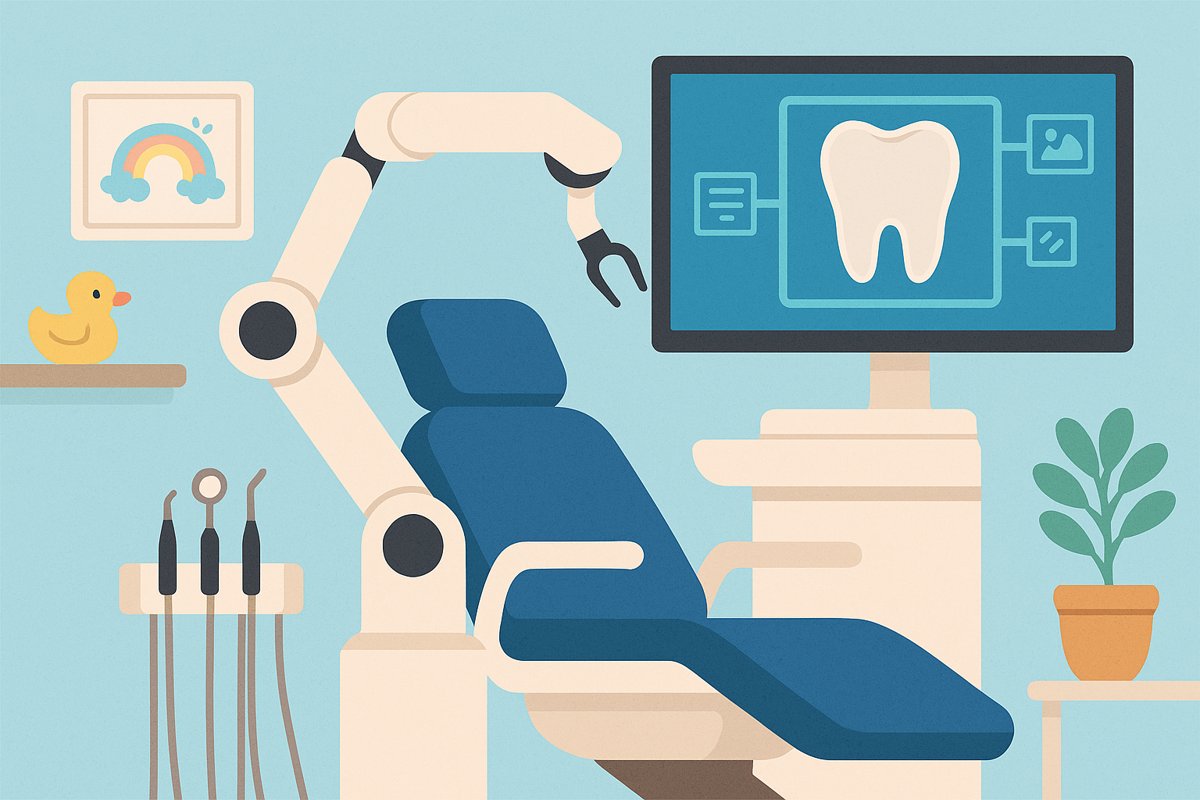
- Dental robots : in China, an implant placement performed entirely by a robot has been successfully tested. Without going that far in Switzerland for now, robotic assistance could help with certain repetitive or high-precision tasks. Always under human supervision, of course.
All these advances share a common goal: making care more precise, faster, and less invasive (as experts point out). For you, this means less pain, less time in the chair, and even more reliable results.
The dentist of tomorrow: high-tech and still human
Even so, let’s not forget that people remain at the heart of dental care. All the technology in the world will never replace the clinical judgment of the dentist, nor their dexterity, nor the empathy they show their patients. The ideal future is therefore a synergy: a highly skilled dentist, enhanced by high-tech tools that multiply their effectiveness.
Picture this, 10 years from now: you walk into a dental clinic, an instant 3D scan of your mouth is taken, and AI compares it with your previous scans and tells the dentist, “All clear, except perhaps an early cavity here.” The dentist confirms and prints a small 3D inlay in 15 minutes to fix it right away, while a robotic assistant prepares the instruments. You leave having had everything done in a single one-hour session, pain-free, and confident that everything has been optimized.
It’s not that far off: many of these elements already exist separately, and it’s a matter of bringing them together. At Aura, we follow these innovations closely and have already adopted some of them (digital imaging, digital impressions, latest-generation rotary instruments). Our goal has always been to offer cutting-edge care, but with a caring, human face. The future of dentistry follows in that same spirit: 100% kindness, 0% judgment, and… more and more technology working for your health.
Conclusion: a bright future for your smile
The future of dental care looks exciting. AI will make diagnoses safer and sharper, 3D printing and robotics will speed up treatments, and connected prevention will involve you in your care every day. All of this translates into dental care that is more precise, faster, and less invasive for patients. In other words, your teeth will be cared for better and more easily than ever before.
And there’s no need to wait: many innovative clinics in Geneva and elsewhere already use some of these technologies. Feel free to ask your dentist about them and how these advances could benefit your own oral health. One thing is certain: your smile has a bright future ahead thanks to all these innovations, and that’s excellent news! 😃



Book an appointment
We give you the flexibility to schedule an appointment however you prefer, whether by calling us directly or using our online booking system.