













How long does it really take to straighten teeth? – Invisalign, braces, express options
Invisalign, braces, express options: realistic timelines.
Orthodontic treatment length: everything you need to know
If you dream of a well-aligned smile, you’ve probably wondered: how long will I have to wear braces? The answer isn’t set in stone (or in enamel 😉) because every case is unique. However, we can give you time ranges for the different modern orthodontic methods – from classic metal braces to clear aligners like Invisalign, including “accelerated” options. You’ll see that straightening your teeth is a project lasting a few months to a few years, but it’s well worth it. Be patient – your new smile is waiting at the end of the road!
Factors that affect treatment length
Before talking numbers, it’s important to understand that the length of orthodontic treatment depends on several factors:
- How complex the case is : Correcting slight crowding or closing a small gap takes much less time than treating severe misalignment or a poorly positioned jaw. The more tooth movement is needed, the more patience is required.
- The patient’s age : In general, teenagers’ teeth move a little faster than adults’ because growth isn’t fully complete and the bone is more malleable. But rest assured, teeth can be straightened very well at any age (at Aura in Geneva, we regularly provideadult orthodontics ). It may just take a few extra months for someone in their forties compared with a teenager.
- The type of appliance used : Each technique has its own features. Traditional braces are effective for all types of tooth movement, while clear aligners perform very well in moderate cases but can be slightly slower for certain complex corrections. There are also “cosmetic” appliances (ceramic braces, lingual braces bonded behind the teeth) whose mechanics may differ slightly.
- Patient cooperation : That’s right, you play a role! With Invisalign, for example, treatment can drag on if you don’t wear your aligners at least 22 hours a day . Likewise, it’s important to keep the check-up and adjustment appointments scheduled by your practitioner – their availability and yours can affect the total duration. A diligent patient often finishes treatment on schedule.
Metal braces: 1.5 to 3 years on average
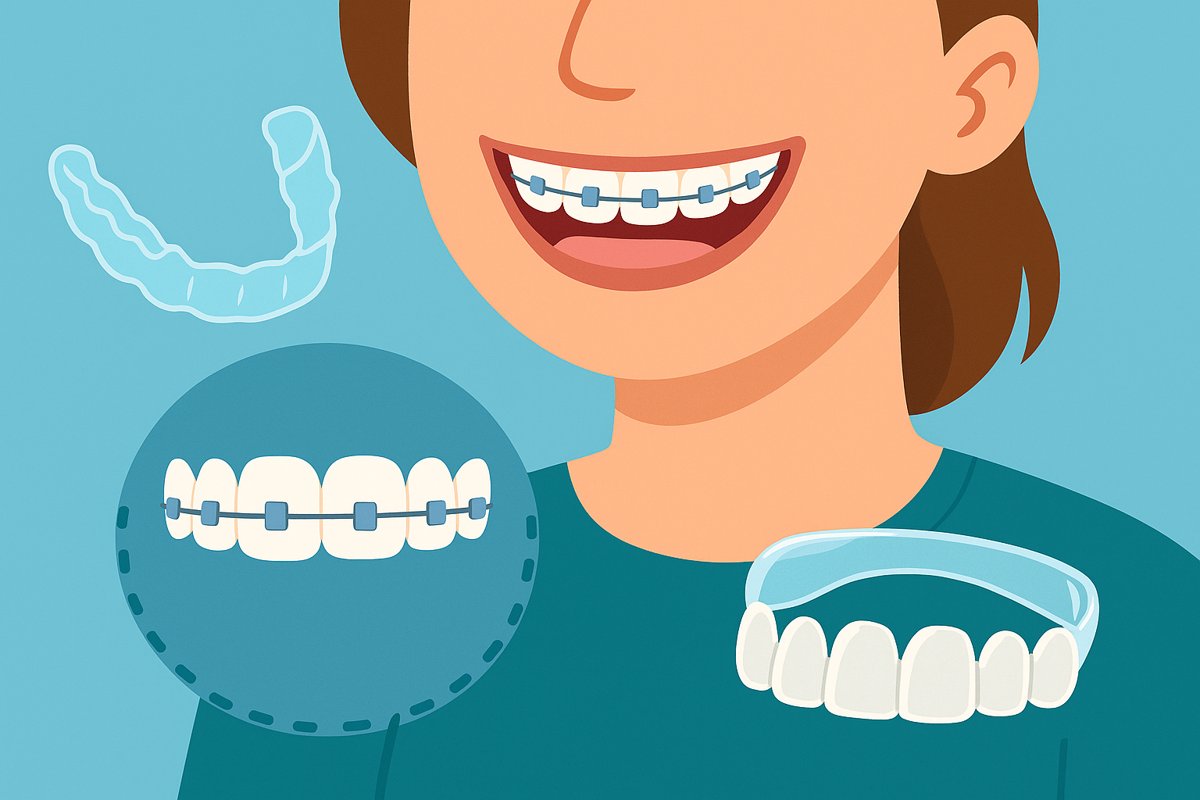
The fixed braces treatment (the “brackets” bonded to the teeth and connected by a wire) is the traditional method. For an average teenager, expect about 18 to 24 months of active treatment. This can drop to 12 months for a minor correction, or rise to 30-36 months for a very complex case (for example, impacted teeth that need to be exposed, or a bite requiring major correction).
Why so long? Because the orthodontist moves each tooth little by little, in a specific order, to achieve ideal alignment while protecting the health of your teeth. The bone around the roots needs time to remodel. Generally, the first results show within a few months (the most visible teeth line up), but fine-tuning the perfect bite (occlusion) and stability can take more than a year after that. Don’t get discouraged along the way: every appointment brings you closer to your goal. And today’s wires perform better (super-elastic nickel-titanium technology), so gentle, continuous forces are applied – your teeth move more efficiently than they did 20 years ago.
Invisalign aligners: 3 to 24 months depending on the case
Clear aligners such as Invisalign have revolutionized adult orthodontics. This system involves wearing a series of custom-made plastic aligners that gradually move the teeth. Here too, the length of aligner treatment depends on how complex the case is:
- For slight spacing or crowding of the front teeth, there are options such as Invisalign Lite or similar, which can be completed in 3 to 9 months. This is the express option for small cosmetic corrections (sometimes called “smile ortho”).
- For a standard case (several misaligned teeth in the arches, a bite needing minor adjustment), treatment often takes around 12 to 18 months . In this respect, it’s comparable to traditional braces.
- For complex situations (deep bite, significant tooth rotation, etc.), Invisalign can take up to 24 months or a little longer, and sometimes attachments (small bumps bonded to the teeth) and inter-arch elastics are used, just as with braces. Beyond 2 years, if a lot remains to be done, the dentist may recommend switching to traditional braces to finish the job more efficiently. But that’s rare – most Invisalign plans fit within 2 years.
Where Invisalign saves time is that appointments can sometimes be spaced a little further apart (you change your aligners yourself every 1-2 weeks). Fewer visits means less disruption to your schedule. Be careful, though: if you’re not disciplined about wearing your aligners, treatment can stall. Simply put, an estimated 18 months assumes you wear them full-time. If you take them out too often, treatment will take longer accordingly.
Are there faster methods?
You may have heard of “6 Month Smiles” or other accelerated treatments. What are they? In fact, they’re generallylimited orthodontics focused on the smile zone. Basically, only the visible front teeth are aligned, without much concern for the overall bite. This makes it possible to go faster (sometimes ~6 months, in fact), but the result is purely cosmetic, not functional. It’s only appropriate if your bite is correct to begin with and you just want to correct the alignment of your incisors and canines.
Other approaches to save time include surgically accelerated orthodontics (making micro-incisions in the bone to facilitate and speed up tooth movement) or using vibrating devices like AcceleDent at home to stimulate faster movement. Studies on these techniques show mixed results regarding their real effectiveness, and they’re rarely necessary. Talk to your orthodontist if timing is crucial for you – in certain special cases, they may suggest an acceleration protocol. But keep in mind that the priority is the quality and stability of the result, more than shaving off a few weeks at all costs.
And after alignment… retention!
Once your teeth are perfectly aligned and the appliance is removed, it’s not quite over (surprise 😅). You need to plan for a retention period to hold the teeth in place while the bone firms up and the elastic memory of the fibers fades. This phase generally lasts as long as the active treatment itself, if not longer. It consists either of a thin wire bonded behind the teeth (a discreet fixed retainer) or night-time aligners to be worn regularly. Whatever you do, don’t neglect this final step, or your teeth could shift back slowly toward their original position (it would be a shame for all that effort to go to waste). Your dentist will explain the right retention protocol for you – for life, remember to wear your night-time retainers from time to time to keep your results stable.
Conclusion: time will pass anyway… so make the most of it to get the smile of your dreams
Whether it’s 3 months, 18 months, or 3 years, remember thatstraightening your teeth is a temporary investment for lasting benefits. Time will pass no matter what, so you might as well end that period with a straight, harmonious smile you’ll be proud of for the rest of your life. At Aura, dental clinic in Geneva, we create a customized schedule for each patient, giving you an estimate of treatment length from the start. No false promises – we’d rather say 24 months and finish in 20 than the other way around. 😉
Ultimately, how long does it take to straighten teeth ? Most of the time, expect around 1.5 years. It may be a little less with clear aligners for simple cases, or a little more with braces for complex ones. But in every case, each month that goes by brings you closer to your goal. Imagine your newfound confidence and the comfort of a good bite… That’s well worth a few months of patience! Don’t hesitate to see a dentist in Geneva specializing in orthodontics for a personalized diagnosis – the sooner the better, because the earlier a problem is addressed, the faster it can be corrected.



Book an appointment
We give you the flexibility to schedule an appointment however you prefer, whether by calling us directly or using our online booking system.